

Endorsed by: Matteo Tretti Clementoni MD, James Chelnis MD & Dorina Cheles MD
Introduction
Rosacea, a multifactorial chronic inflammatory skin disorder, presents primarily on the central face as persistent Erythema, recurrent flushing, Telangiectasia (dilated capillaries), papules and pustules, and in some cases, thickened or nodular skin1,2. Patients may also experience burning, itching and stinging, all of which may impair their quality of life3. Anxiety, depression, and social withdrawal are also reported by patients 3,4. While Rosacea is most prevalent among fair-skinned women over the age of 30, it is increasingly recognized among individuals of Asian, African, and Latin American descent5.
Rosacea can be managed by topical agents, such as alpha-adrenergic agonists antiparasitics, and antibiotics that can temporarily reduce facial redness through vasoconstriction, but these effects are often short-lived 1,6–8. Oral medications that provide systemic anti-inflammatory action are also available but demonstrate limited efficacy against persistent background redness or visible Telangiectasia and can be accompanied by systemic side effects 9–11. Light-based therapies, such as laser and Intense Pulsed Light, are effective treatment options for rosacea, particularly for reducing redness and visible blood vessels. Long-term management includes gentle skincare and photoprotection1.
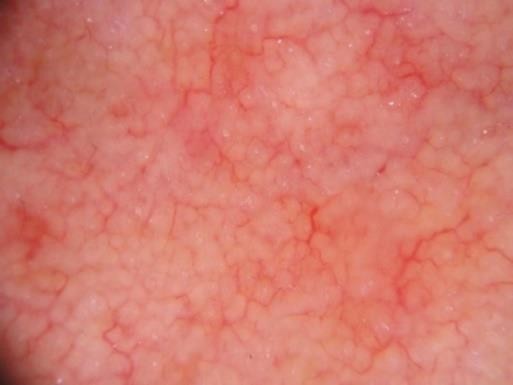
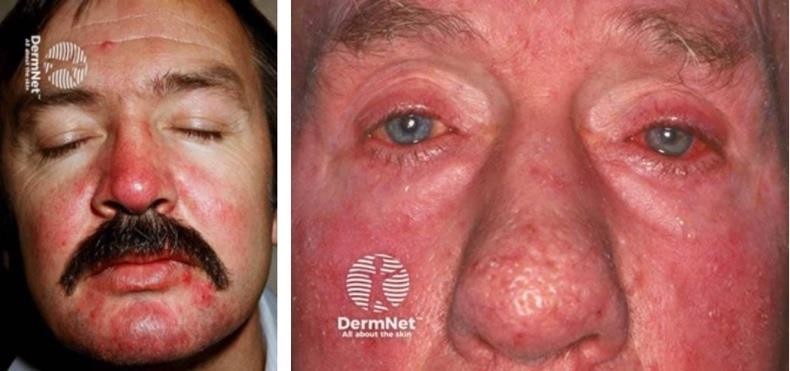
Subtypes of Rosacea
Of the numerous types of rosacea, two types are amenable to treatment with light-based therapies12–15:
Erythematotelangiectatic Rosacea (ETR) is characterized by persistent facial redness (non-transient erythema), flushing, and visible Telangiectasia (dilated blood vessels), primarily on the cheeks, nose, chin, and forehead. Patients often report heightened skin sensitivity, burning, or stinging sensations. Triggers include heat, alcohol, spicy food, and stress, all of which can exacerbate symptoms. ETR, particularly the fixed background redness, can be difficult to treat, and is often resistant to topical or systemic therapy. Recommended treatment frequently includes pulsed light and vascular laser treatments to reduce visible vessels.
Papulopustular Rosacea (PPR) is characterized by acne-like breakouts, including inflammatory papules and pustules, that appear in the background of erythema. Unlike acne vulgaris, it typically lacks comedones and affects older adults. PPR is more common in middle-aged women and can overlap with ETR. This subtype often responds well to topical and oral anti-inflammatory agents.
Pulsed Light for Rosacea Treatment
Light-based therapies, especially pulsed light, a non-laser light therapy, are effective, non-invasive, safe options for treating the vascular components of Rosacea observed in ETR and PPR. Pulsed light treats the redness and flushing of Rosacea. For many patients, it significantly improves both the physical signs of Rosacea and the overall quality of life.
Pulsed light emits high-intensity pulses of broad-spectrum light that cause thermal injury to specific targets, such as blood vessels, largely without damaging surrounding tissues. For Rosacea, the filtered Pulsed light pulse is focused on an area of skin with dilated blood vessels. The blood (hemoglobin) in the vessels absorbs the energy and converts it to heat, thereby heating the vessel wall and causing it to collapse or coagulate. Pulsed light is generally gentler on the skin than laser therapy (e.g., Pulsed Dye Laser) and typically does not result in bruising, reducing recovery time to a minimum. The damaged vessels are removed by the body’s natural healing processes over days to weeks. More and more of the superficial vasculature is destroyed or remodeled with each treatment, reducing redness. A full treatment course can dramatically reduce overall facial flushing and redness. A typical treatment course consists of 3-6 sessions spaced about one month apart, depending on the severity of redness and the skin’s response, with maintenance treatments every 6-12 months to sustain results. Vessels of varying sizes and depths can be targeted in one session due to the broad spectrum and wavelength range of pulsed light. Shorter wavelengths in the pulse target small superficial red vessels, while longer wavelengths penetrate deeper, reaching some of the larger, deeper Telangiectasia.
Beyond targeting blood vessels, intense pulsed light has anti-inflammatory effects and supports barrier repair, thus improving skin quality. The results are generally longer lasting compared to topical agents, and side effects, such as transient redness or mild swelling, are typically mild and self-limited. Importantly, Pulsed light can complement pharmacological therapies.
Pulsed light has also been noted to stimulate collagen remodeling due to its gentle heating effect, resulting in improved skin texture, and reduced pore size and fine lines in the dermis. In rosacea patients, this collagen boost may also result in skin that is less reactive and vessels that are less prone to dilating. Some patients with coexisting issues such as sunspots or uneven pigmentation often report improvement with Pulsed light, since certain filters target melanin.
Stellar M22™ Pulsed light for Rosacea Treatment
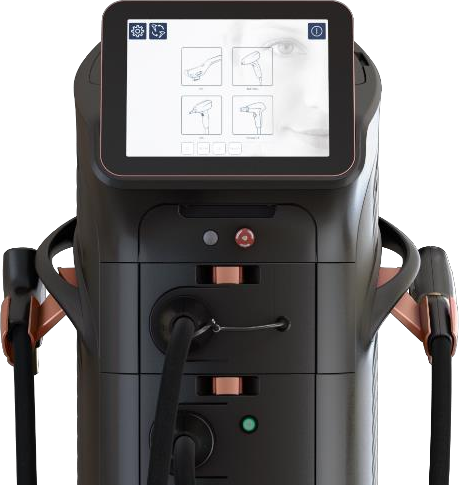
Stellar M22 is a modular system comprising four high-end technologies that provide treatment options for more than 30 skin conditions, including photorejuvenation, pigmentation, vascular lesions, rosacea, scars, textural issues, and hair removal. Stellar M22 pulsed light module delivers multiple sequential pulsing, as single, double or triple synchronized pulses, protecting the epidermis and improving the efficacy of vascular lesion clearance. The tissue cools between pulses, allowing more energy to safely reach the target, while reducing incidence of skin damage in vascular lesion treatment.
Support for Stellar M22 Pulsed Light
Numerous trials have demonstrated significant positive effects of pulsed light on rosacea symptoms, with visible clearing of redness16. Patients often report a decrease in flushing frequency, a decrease in the intensity and severity of these episodes, and a marked sustained reduction in erythema following a full course of pulsed light therapy.
Pulsed light provides improvement in rosacea symptoms equivalent to that achieved with pulsed dye laser 10,17.
Post treatment responses are transient16, with temporary redness, swelling, or change of pigmentation. There are no reports of serious or systematic complications.
Patients are highly satisfied with the improvement in appearance (less redness, more even skin tone) and often report accompanying improved confidence and improvement in quality-of-life scores post-treatment. Many patients often return for yearly maintenance after seeing the results of pulsed light treatment.
Improvement in Rosacea resulting from pulsed light can last for a few months. While the condition may gradually recur without ongoing therapy, it usually does not return to its original severity for a long time and can be effectively controlled with maintenance treatments (every 6-12 months).
Unlike topical and oral medications, pulsed light does not demand ongoing refills and daily use. This is critical in building a treatment plan for patients that encourages compliance over long periods of time.
Many dermatologists consider pulsed light as a first-line treatment for ETR. Experts include laser/pulsed light as a standard option for persistent redness and Telangiectasia, often in combination with medical therapies for a holistic approach.
Clinical Data
Clinical experience data is collected during treatments analyzed by WiZ software (by Lumenis). The Stellar M22 may be1 connected with WiZ capabilities through an external device (the “WiZ Box”), that powered by IoT technology. WiZ enables clinicians to optimize business, clinical, and operational performance using real-time data. It gives clinicians a competitive edge by enabling them to benchmark the performance of their Stellar device against data from other clinics. Additionally, WiZ offers remote connectivity for VIP service and support, as well as 24/7 device monitoring with proactive and predictive maintenance helping to drive maximum device uptime.
The treatments analysis presented below includes anonymized patient demographics, the distribution of clinical indications, and the most common filters used for rosacea and telangiectasia treatment. In total, 297,547 treatments were recorded between December 2020 and April 2025 in the U.S. Market, of which 51,890 treatments were performed under the vascular lesions’ application category.
1 Per regulatory approval in the relevant territory.
Patient’s Demographics
The overall age distribution of patients treated with Stellar M22 (N=82,817) is shown in Figure 3.A. The largest group age 30-39 years (29%), followed by 40-49 years (27%) and 50-59 years (17%). Younger adults (20-29 years) represent 16%, while patients aged 60 years and above account for 11%.
By gender, the distribution patterns are similar. The 30–39-year group is the most common in both females (29%) and males (26%), followed by 40-49 years (28% and 24%) respectively. Notably, males show a higher proportion in the 60+ category (17% vs. 10% in females) (Figure 3.B-C.).
Distribution of Skin Types and Clinical Indications
WiZ data analysis (recorded and documented) of Stellar M22 treatments includes information on patients’ skin types (ST) within the Vascular Lesions (VL) Application and specifically for rosacea (Figure 4.A and 4.B) respectively, and the distribution of clinical indications within the VL Application (Figure 4.C). The results show that most pulsed light treatments are performed on patients with skin types II (36%) and III (34%), which together account for more than two-thirds of all cases. Skin type IV represents 23%, while the extremes type I (3%) and type V (4%) are less common.
Within rosacea treatments (Figure 4.B), the skin type distribution follows a similar pattern, with the majority falling within Types II-III-IV (29%, 33%, and 31%, respectively).
Regarding clinical indications (Figure 4C), treatments primarily target telangiectasia (66%) and rosacea (27%), which together make up the vast majority of vascular lesion cases. Other conditions, such as hemangioma, leg veins, and Port-Wine Stains (PWS), are less frequently treated. Overall, the data indicates that telangiectasia, rosacea and erythema of rosacea are the leading treatment drivers within the vascular lesions’ application, especially among lighter skin types.
Commonly Used Filters2
The WiZ data analysis of Stellar M22 pulsed light treatment parameters reveals distinct preferences in filter selection between telangiectasia and rosacea (Figure 5).
For telangiectasia, the Vascular Filter (530-650 & 900-1200 nm) is used in the majority of cases (over 70%), reflecting its suitability for superficial and deeper vascular targets. Other filters, including 560nm (17%) and 590nm (~7%), are used less frequently, while the remaining filters contributed only marginally (Figure 5.A).
In contrast, rosacea and erythema of rosacea treatments show a different pattern, with the 560nm (~44%) and 590nm (~50%) filters being most applied. The use of other filters, including the Vascular Filter, is minimal (Figure 5.B).
These findings suggest that effective rosacea and erythema of rosacea treatments often require multiple filters within the same session to target vessels of varying diameters, depths and hemodynamicity, optimizing clinical outcomes.
2 Acne filter was excluded from data analysis.
Clinical Evaluation
A total of 15 eligible and healthy patients aged 21-80 years and skin types I-V were enrolled. Each patient received up to four Stellar M22 pulsed light treatments at intervals of 4-6 weeks, followed by a 1-month post-treatment follow-up. Most of the enrolled patients (66%) were aged 35 to 45 years old, Caucasian and with skin types II-IV.
Patients rated pain and discomfort experienced during or after treatment using a 0-10 Likert Scale, where 0 represented “no pain” and 10 indicated “intolerable pain.” Immediate and short-term responses (erythema, edema, purpura, etc.) were also assessed. Downtime was defined as the period in which patients experienced erythema and edema accompanied by discomfort. In addition, overall patient satisfaction and perceived improvement were evaluated, while physicians assessed clinical improvement at each visit by comparing post-treatment photographs to baseline images.
The results demonstrated that pulsed light treatment was safe and consistent with previously published literature 18–20. Patients reported mild discomfort (rated 2-4/10) 21, typically described as a brief sting or snap, a common sensation during pulsed light procedures. Temporary redness and swelling, similar to a mild sunburn were the most frequent reactions and resolved within 24-48 hours. Rare side effects, such as transient bruising or a flushed appearance in sensitive patients, were also observed. There is a greater risk of pigmentation changes in darker skin types, this can be mitigated through careful patient selection and appropriate parameter adjustments such as longer pulse duration and delay time.
Clinically, pulsed light treatment significantly reduced persistent erythema and telangiectasia, with moderate to good improvement (50-75%) that observed one month after the first treatment, and good to excellent improvement (80-90%) at the end of treatment series. Many patients also reported shorter and less intense flushing episodes following treatment. Noticeable improvements were typically seen after two sessions, with optimal outcomes achieved after four sessions. Each patient evaluated the overall treatment experience including rosacea improvement and satisfaction by using a 5-point score. The majority of patients were very satisfied with the treatment process and the improvement that was achieved.
Treatment Guidelines
The following tables summarize the treatment guidelines for treating rosacea, erythema of rosacea, and telangiectasia. They present the recommended settings and commonly used filters for these clinical indications, highlighting the practical parameters most often used in routine treatments. These tables serve as a quick reference for clinical decision-making.
Treatment guidelines for rosacea and erythema of rosacea are presented in Table 1. Telangiectasia guidelines are divided into two groups: cutoff filters (Table 2) or the Vascular filter (Table 3). The Vascular filter is particularly effective for treating stubborn vessels, visible margins, and quick hemodynamicity.
| Parameters | Skin Types I-III | Skin Type IV | Skin Type V |
|---|---|---|---|
| Lightguide | Rectangular | Rectangular | Rectangular |
| Filter (nm) | 590, 560 | 640, 590 | 640, 590 |
| Pulse Type | Double 4ms | Double 5ms | Triple 4ms |
| Pulse Delay (ms) | 20 | 35-40 | 40-45 |
| Fluence (J/cm²) | 18-19 | 17-18 | 16-18 |
Note: Start the treatment with a first pass using the longer wavelength.
| Parameters | Skin Types I-III | Skin Type IV | Skin Type V |
|---|---|---|---|
| Lightguide | Ø6 | Ø6 | Ø6 |
| Filter (nm) | 515, 560 | 590 | 590 |
| Pulse Type | Double 3.5-4ms | Double 4-5ms | Triple 4.5ms |
| Pulse Delay (ms) | 15-25 | 25-30 | 40 |
| Fluence (J/cm²) | 28-32 | 25-28 | 25-28 |
Note: Treat first the deepest vascular telangiectasia with the longer wavelength, then move to the superficial with the shorter wavelength. The 515nm filter is intended only for skin types I-II.
| Parameters | Skin Types I-III | Skin Type IV | Skin Type V |
|---|---|---|---|
| Lightguide | Ø6 | Ø6 | Ø6 |
| Filter (nm) | Vascular | Vascular | Vascular |
| Pulse Type | Double 3.5-4.5ms | Double 4-5ms | Double 4.5ms |
| Pulse Delay (ms) | 15-20 | 25-30 | 40 |
| Fluence (J/cm²) | 27-30 | 26-28 | 25-27 |
Note: It is crucial to determine the Fitzpatrick Skin Type, identify the type of rosacea and its severity. Before full treatment, it is recommended to perform a test spot on a small area and evaluate the skin response after 20-30 minutes for skin types I-III, 24-48 hours for skin type IV, and 48-72 hours for skin type V.
Along with a good response in the vessel, if adverse skin effects occur (such as excessive reddening or swelling in the shape of the lightguide), adjust the treatment parameters to reduce the intensity of the treatment. The intensity may be reduced by the following actions in the following order:
- Decreasing fluence.
- Increasing the pulse delay.
- Increasing pulse duration.
- Using a longer wavelength filter.
- Increasing the number of pulses.
Typical Clinical Results
The following before-and-after images showcase the visible results typically achieved with rosacea and telangiectasia treatment using Stellar M22 pulsed light, highlighting the treatment protocol, suitable skin types, and any reported side effects.
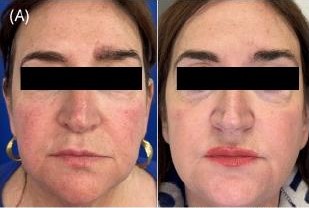
(A) A single treatment of rosacea: rectangular LG, 560nm, double pulse 4ms, delay 20ms, fluence 19J/cm². Telangiectasia: rectangular LG, Vascular, double pulse 4ms, delay 20ms, 20J/cm². Single pass. Side effects: mild pain (1-3/10); mild erythema.
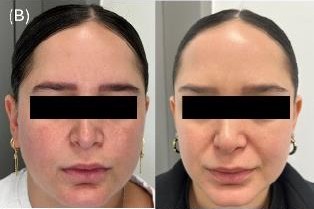
(B) A single treatment of rosacea: rectangular LG, 560nm, double pulse 4ms, delay 20ms, fluence 19J/cm². Single pass. Side effects: moderate pain (4-6/10); moderate erythema and mild edema.
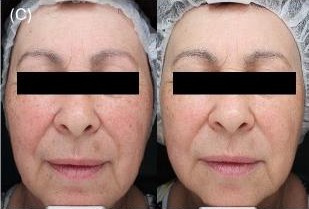
(C) Rosacea: rectangular LG, 590nm, double pulse 4ms, delay 20ms, fluence 19J/cm² followed by a second pass with 560nm double pulse 4ms, delay 20ms fluence 16J/cm². Pigmentation: a third pass was applied using the 515nm, single 4ms and fluence 14J/cm².
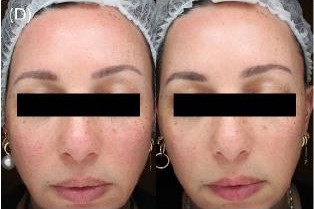
(D) A single treatment of rosacea: rectangular LG, 560nm, double pulse 4ms, delay 20ms, fluence 19J/cm². Single pass. Side effects: mild pain (2/10); moderate erythema and mild edema.
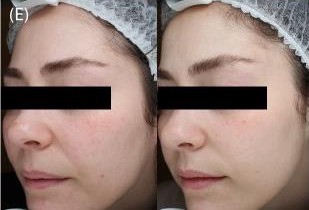
(E) Rosacea: rectangular LG, 560nm, double pulse 4ms, delay 15ms, fluence 17J/cm². 2 passes. Telangiectasia: round LG, Vascular, double pulse 3.5ms, delay 15ms, 30J/cm². Single pass. Side effects: mild pain; mild erythema.
Why Stellar M22 Pulsed Light for Rosacea?
The Stellar M22 pulsed light is a versatile and clinically validated solution for the effective management of rosacea. By precisely targeting vascular and inflammatory components, it helps reduce redness, flushing, and visible blood vessels, while also stimulating collagen and elastic fiber production to improve overall skin quality. With minimal downtime, customizable settings, and proven outcomes, it provides physicians with a reliable treatment option and offers patients long-lasting relief, improved appearance, and renewed confidence in their skin.
Reference
- 1.Thiboutot D, Anderson R, Cook-Bolden F, et al. Standard management options for rosacea: The 2019 update by the National Rosacea Society Expert Committee. J Am Acad Dermatol. 2020;82(6):1501-1510.
- 2.van Zuuren EJ. Rosacea. New England Journal of Medicine. 2017;377(18):1754-1764.
- 3.Rademaker M. Very low‐dose isotretinoin in mild to moderate papulopustular rosacea; a retrospective review of 52 patients. Australasian Journal of Dermatology. 2018;59(1):26-30.
- 4.Shemer A, Gupta AK, Kassem R, Sharon N, Quinlan EM, Galili E. Low‐dose isotretinoin versus minocycline in the treatment of rosacea. Dermatol Ther. 2021;34(4):e14986.
- 5.Alexis AF, Callender VD, Baldwin HE, Desai SR, Rendon MI, Taylor SC. Global epidemiology and clinical spectrum of rosacea, highlighting skin of color: review and clinical practice experience. J Am Acad Dermatol. 2019;80(6):1722-1729.
- 6.Baumann L, Goldberg DJ, Tanghetti EA, et al. Pivotal trial of the efficacy and safety of oxymetazoline cream 1.0% for the treatment of persistent facial erythema associated with rosacea: findings from the second REVEAL trial. J Drugs Dermatol. 2018;17(3):290-298.
- 7.van Zuuren EJ, Fedorowicz Z, Tan J, et al. Interventions for rosacea based on the phenotype approach: an updated systematic review including GRADE assessments. British Journal of Dermatology. 2019;181(1):65-79.
- 8.Fowler J, Jarratt M, Moore A, et al. Once‐daily topical brimonidine tartrate gel 0.5% is a novel treatment for moderate to severe facial erythema of rosacea: results of two multicentre, randomized and vehicle‐controlled studies. British Journal of Dermatology. 2012;166(3):633-641.
- 9.Desai S, Friedman A. Isotretinoin for rosacea: A systematic review. JAAD Int. 2024;16:112-118.
- 10.Zhai Q, Cheng S, Liu R, Xie J, Han X, Yu Z. Meta‐Analysis of the Efficacy of Intense Pulsed Light and Pulsed‐Dye Laser Therapy in the Management of Rosacea. J Cosmet Dermatol. 2024;23(12):3821-3827.
- 11.Ertl GA, Levine N, Kligman AM. A comparison of the efficacy of topical tretinoin and low-dose oral isotretinoin in rosacea. Arch Dermatol. 1994;130(3):319-324.
- 12.Del Rosso JQ. Management of facial erythema of rosacea: what is the role of topical α-adrenergic receptor agonist therapy? J Am Acad Dermatol. 2013;69(6):S44-S56.
- 13.Tan J, Berg M. Rosacea: current state of epidemiology. J Am Acad Dermatol. 2013;69(6):S27-S35.
- 14.Two AM, Wu W, Gallo RL, Hata TR. Rosacea: part I. Introduction, categorization, histology, pathogenesis, and risk factors. J Am Acad Dermatol. 2015;72(5):749-758.
- 15.Wilkin J, Dahl M, Detmar M, et al. Standard classification of rosacea: report of the National Rosacea Society Expert Committee on the Classification and Staging of Rosacea. J Am Acad Dermatol. 2002;46(4):584-587.
- 16.Martignago CCS, Bonifacio M, Ascimann LT, et al. Efficacy and safety of intense pulsed light in rosacea: A systematic review. Indian J Dermatol Venereol Leprol. 2024;90(5):599-605.
- 17.Ruan J, Zheng Y, Cai S. Efficacy and safety comparison between pulsed dye laser and intense pulsed light configured with different wavelength bands in treating erythematotelangiectatic rosacea. Lasers Med Sci. 2024;39(1):146.
- 18.Sperber BR, Walling HW, Arpey CJ, Whitaker DC. Vesiculobullous eruption from intense pulsed light treatment. Dermatologic surgery. 2005;31(3):345-349.
- 19.Greve B, Raulin C. Professional errors caused by lasers and intense pulsed light technology in dermatology and aesthetic medicine: preventive strategies and case studies. Dermatologic surgery. 2002;28(2):156-161.
- 20.Ullmann Y, Elkhatib R, Fodor L. The aesthetic applications of intense pulsed light using the Lumenis M-22 device. Laser Ther. 2011;20(1):23-28.
- 21.Galeckas KJ, Collins M, Ross EV, Uebelhoer NS. Split-face treatment of facial dyschromia: pulsed dye laser with a compression handpiece versus intense pulsed light. Dermatologic surgery. 2008;34(5):672-680.
- 22.Sgouros D, Apalla Z, Ioannides D, et al. Dermoscopy of common inflammatory disorders. Dermatol Clin. 2018;36(4):359-368.
LUMENIS Be does not make recommendations regarding the practice of medicine.
These settings are provided as a guide only.
Individual treatment should be based on clinical training, clinical observation of laser-tissue interaction, and appropriate clinical end-points.
For complete Stellar M22™ usage instructions, safety measures and patient care to be observed, please refer to the Operator’s Manual and to the Clinical In-Service Guidelines & collaterals specific to the light source intended for use.
With changing input condition at every session, adjust settings as per Clinical In-Service guidelines.
Indication of use: The Stellar M22 has connection capability with the following available treatment modules: XPL, ResurFX, Multi-Spot Nd:YAG and Q-Switched Nd:YAG– for multi-application treatment options. All modules and handpieces are designed for aesthetic and dermatological skin procedure applications. See the Operator’s Manual for a complete regional list of approved indications.
Warning and risks: Possible side effects following Stellar M22 treatments are: discomfort, damage to natural skin texture, change of pigmentation, scarring, excessive swelling, fragile skin, bruising, burns, pruritus and xerosis.
General Stellar M22 contraindications are:
- Active infections.
- Dysplastic nevi.
- Significant concurrent skin conditions or any inflammatory skin conditions.
- Active cold sores, open lacerations or abrasions.
- Chronic or cutaneous viral, fungal or bacterial diseases.
Treatment should not be attempted on patients with a history or concurrent condition of skin cancer or pre-cancerous lesions at the treatment areas.
See the system’s Operator’s Manual for a complete list of contraindications and risks.
Note: This publication is relevant to all Stellar M22™ configurations.
CD-2006011_B
Author: Rula Masoud, Senior Clinical Manager & MAP Lead, Lumenis
Linkedin